


Shandong Kosman Environmental Technology Co., Ltd. is one of the leading manufacturers and suppliers of three-stage condensate recovery unit in China. Please feel free to buy premium equipment for sale here and get pricelist from our factory. All customized products are with high quality and low price.
I. Product Overview
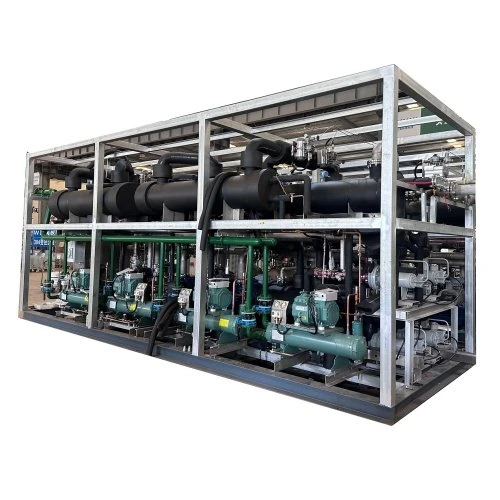
The three-stage condensation Vapor recovery unit is specialized environmental protection equipment that utilizes multi-stage gradient cooling technology to recover volatile organic compounds (VOCs) by condensing them from the gas phase into a liquid state. The unit employs a three-stage cascade condensation system, liquefying and separating various hydrocarbon components from the Vapor stream sequentially through progressive cooling.
Compared to single-stage or two-stage condensation, the three-stage condensation process utilizes a more refined temperature gradient design, capable of lowering system temperatures to between -75°C and -115°C, thereby significantly increasing the recovery rate of light hydrocarbon components. This product is widely used for high-concentration VOC treatment and resource recovery in sectors such as gas stations, oil depots, refining and petrochemical enterprises, and the chemical and pharmaceutical industries.
II. Technical Principles
2.1 Core Working Principle
Condensation-based recovery relies on the principle that the saturated vapor pressure of a substance varies with temperature; by lowering the temperature, the vapor pressure of hydrocarbon components in the Vapor stream reaches a state of supersaturation, causing them to condense into liquid and separate out.
The three-stage condensation unit utilizes multi-stage cascade refrigeration technology, employing three independent refrigeration cycles to supply cooling at different temperature levels to three separate condensation channels. During operation, high-temperature, high-pressure refrigerant gas discharged from the compressor enters the condenser and is condensed into high-pressure liquid. It then passes through an expansion valve, undergoing throttling and pressure reduction to become a low-temperature, low-pressure gas-liquid mixture before entering the evaporator. There, it absorbs heat from the Vapor stream and vaporizes, after which it is drawn back into the compressor to begin the next cycle. The entire system continuously repeats this process to achieve the ongoing cooling and recovery of Vapor.
2.2 Three-Stage Cascade Condensation Process
|
Condensation Stage |
Typical Temperature |
Function Description |
|
First-stage Condensation (Pre-cooling) |
0°C – 5°C |
Removes moisture and heavy components from the gas; prevents frost formation and clogging in downstream stages |
|
Second-stage Condensation (Intermediate Cooling) |
-30°C – -40°C |
Liquefies and recovers the vast majority of organic compounds (C4–C6 components) |
|
Third-stage Condensation (Deep Cooling) |
-65°C – -75°C |
Deeply condenses light hydrocarbon components (C3 and lighter) to ensure high recovery rates |
Certain high-end configurations allow for four-stage cryogenic cooling down to -115°C to further capture low-boiling-point components.
III. Technical Parameters
|
Parameter Item |
Technical Specifications |
|
Condensing Temperature |
Stage 1: 0°C / Stage 2: -30°C to -40°C / Stage 3: -65°C to -75°C (customizable down to -115°C) |
|
Vapor Processing Capacity |
5–3000 Nm³/h (customizable) |
|
NMHC Recovery Rate |
≥93% (at temperatures below -75°C) |
|
Cold Box Pressure Rating |
8 bar |
|
Heat Exchanger Material |
SUS304 stainless steel (customizable) |
|
Explosion-proof Rating |
Ex d IIB T4 / Ex pxdmb IIB T4 |
|
Control System |
Fully automatic PLC control with touchscreen operation |
|
Product Configuration |
Skid-mounted |
IV. Product Advantages
- High recovery efficiency: Three-stage progressive cooling design recovers the vast majority of hydrocarbon components (C3 and heavier), achieving a recovery rate exceeding 93%.
- Direct results: Recovers liquid products directly with precise on-site metering; recovered materials can be reused immediately.
- Inherent safety: Explosion-proof design with no high-temperature combustion processes; suitable for flammable and explosive environments.
- Stable operation: Dual-channel anti-icing design ensures uninterrupted, long-term continuous operation.
- No consumable costs: No need to replace activated carbon; no hazardous waste disposal fees.
- Ease of operation: Fully automatic PLC control with one-touch start/stop and remote monitoring capabilities.
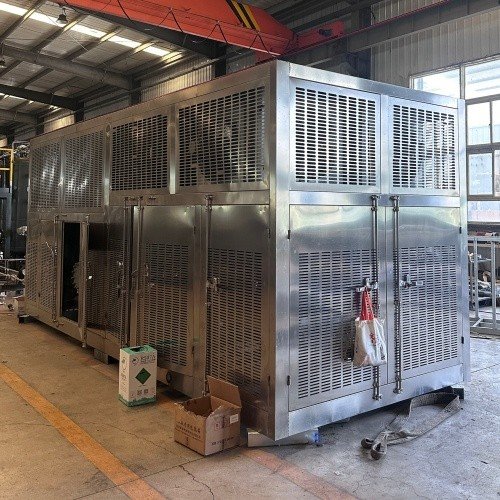
- Skid-mounted design: Compact structure with a small footprint, facilitating easy transport and rapid installation.
- Wide range of media: Capable of processing various VOC gases, including hydrocarbons, aromatics, alcohols, ketones, and esters.
V. Application Scenarios
|
Application Areas |
Typical Scenarios |
|
Oil Storage & Transportation |
Storage tank breathing emissions; vapor recovery during loading (truck/ship) |
|
Gas Stations |
Stage III vapor recovery |
|
Refining & Petrochemical Enterprises |
Intermediate product tank farms; waste gas treatment at loading racks |
|
Chemical & Pharmaceutical Industries |
Solvent vapor recovery from reaction vessels and mixing tanks |
|
Chemical Storage & Transportation |
VOC recovery during the loading, storage, and transport of various volatile chemicals |
Applicable media: Organic gases including hydrocarbons, aromatics, alcohols, ethers, ketones, and esters-such as gasoline, crude oil, diesel, benzene, toluene, xylene, styrene, naphtha, methanol, ethanol, acetone, and ethyl acetate.
VI. Selection Recommendations
|
Evaluation Criteria |
Conditions Suitable for Three-Stage Condensation |
|
Material Type |
Medium- to high-volatility components (e.g., gasoline, naphtha, aromatics, light hydrocarbons) |
|
Inlet Concentration |
High-concentration hydrocarbon vapors (e.g., during loading/unloading operations) |
|
Emission Standards |
Strict requirements; ultra-low emissions must be achieved |
|
Recovery Value |
High value of recovered products; short investment payback period |
|
Site Conditions |
Space constraints; requires compact skid-mounted equipment |
VII. Ordering Information
|
Item |
Details |
|
Product Name |
Three-stage condensation oil & gas recovery unit |
|
Condensation Temperature |
0°C / -30°C to -40°C / -65°C to -75°C (customizable down to -115°C) |
|
Processing Capacity |
5–3000 Nm³/h (customizable) |
|
Explosion-proof Rating |
Ex d IIB T4 / Ex pxdmb IIB T4 |
|
Product Configuration |
Skid-mounted / Stationary |
|
Design Service Life |
≥10 years |
|
Warranty Period |
12–24 months |
|
Optional Features |
Online monitoring system, dual-channel anti-icing design, DCS communication interface |
Specific prices and delivery times are subject to actual quotation.
VIII. Contact Information
Please contact us for further product details, technical solutions, or to obtain a quote.
Hot Tags: three-stage condensate recovery unit, China three-stage condensate recovery unit manufacturers, suppliers, factory